What Color Coat to Buy First When You Can Only Afford One

There is a special kind of pressure that comes with buying your only coat. It is the piece you will reach for every cold morning, the first thing people see when you walk in, and the last thing you take off at the door. Get the color right and every outfit underneath looks finished. Get it wrong and the coat sits unworn. So what color coat to buy first when you can only afford one? The honest answer is that it depends on two things you already own, your closet and your skin tone. This guide walks you through both and compares the four colors worth your money, so you can buy once and wear it for years.
Start With Your Closet, Not the Coat Rack
The biggest mistake people make when they buy their first good coat is choosing the color they love in the store instead of the color that matches what they already own. A coat is the largest single piece of color in any winter outfit. It covers most of what you are wearing, which means it has to get along with nearly everything underneath it. The prettiest coat on the rack is a bad buy if it clashes with half your closet.
Before you shop, take two minutes and do this test. Open your closet and pull out the five outfits you wear most often in cold weather. Lay them on the bed and look at the colors as a group. If most of them are navy, gray, black, and white, you have a cool wardrobe. If most of them are brown, tan, olive, burgundy, and cream, you have a warm wardrobe. If the pile is a genuine mix, you have a mixed wardrobe. Write the answer down, because it decides more than any trend list ever will.
Your first coat should work with most of those five outfits, not just one favorite. A coat that only looks right over a single dress or a single pair of jeans will spend most of the winter hanging in the closet, and a coat that hangs in the closet is money wasted, no matter how little it cost.
While you are looking, check your shoes and bags too. A coat has to agree with the leather already on your feet. Black boots and a black bag point toward a cool coat color. Brown, tan, or cognac boots point toward a warm one. This is the detail people forget, and it is the most common reason a new coat goes unworn.
Then think about where the coat will actually go. One coat has to cover your whole life, usually three settings: work, weekends, and evenings out. A color that is perfect for the office but looks stiff on a Saturday, or lovely for brunch but wrong for a work meeting, is not the right first coat. The winner looks at home in all three.
How Your Skin Tone Changes the Answer
A coat frames your face for half the year, so its color is a skin question as much as a wardrobe question. The right color near your face makes you look rested and bright. The wrong one can make you look tired even on a good day.
The first thing to work out is whether your skin is warm or cool. There are three quick tests, and you can do all of them in your bathroom mirror in daylight.
The jewelry test is the easiest. Hold a gold necklace and a silver necklace against your collarbone. If gold looks like it belongs and silver looks a little harsh, your skin is probably warm. If silver looks clean and natural and gold looks a little yellow against you, your skin is probably cool. If both look fine, you are likely neutral, which means you can borrow from either side.
The vein test is a useful second check. Look at the veins on the inside of your wrist in natural light. If they look greenish, your skin leans warm. If they look bluish or purple, it leans cool. If you genuinely cannot tell, that also points toward neutral.
The white versus cream test is the most telling of all. Hold a bright white top and a soft cream top under your chin, one at a time, and look at your face, not the fabric. Bright white flatters cool skin and can make warm skin look sallow. Soft cream flatters warm skin and can make cool skin look a little gray. The one that makes your eyes look brighter and your skin look clearer is telling you your temperature.
Depth and contrast matter too. If you have fair skin and dark hair, you have high contrast, and you can carry deep, dark coat colors like black and deep navy without them swallowing your face. If your coloring is soft, with light hair and light eyes, or with very little contrast between your features, softer shades like camel and mushroom gray will flatter you more than a hard, dark coat.
When you try a coat on in the store, test it properly. Put it on the way you will wear it, walk to a window, and look at the skin under your eyes, around your mouth, and along your jawline. If the color is wrong for you, you will see a gray or sallow cast in exactly those three places. If the color is right, your skin will look clear and your eyes will look brighter.
If you love a color that is not your best one, keep it away from your face with a scarf in your best neutral. The color near your skin is what matters, and a scarf lets you cheat.
The Four Colors Worth Considering
Once you know your wardrobe and your skin tone, the choice narrows fast. There are really only four colors worth considering for a first and only coat. Here is how each one behaves, honestly, including the downsides.
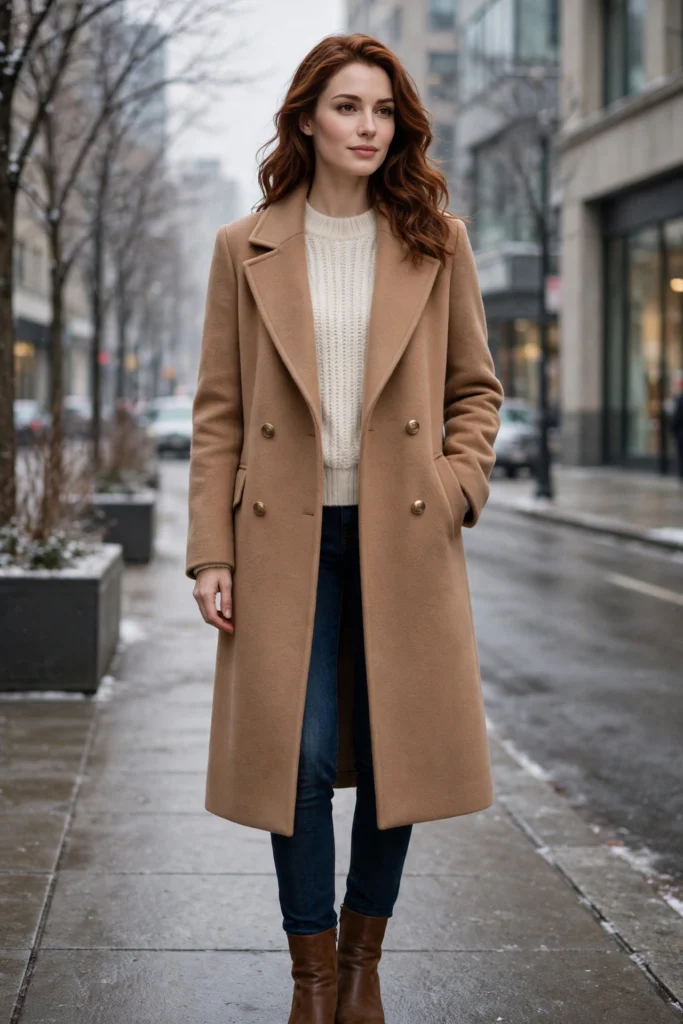
Camel
Camel is the classic, the coat color that has been in style for decades and shows no sign of leaving. It is warm and approachable, and it pairs beautifully with denim, gray, cream, black, navy, and burgundy, which covers most closets. It moves easily from fall to spring, which gives it the longest wearing season of any color here.
Camel flatters warm skin tones best, and it is the natural partner for a warm wardrobe. If your closet is full of browns, tans, olives, and creams, a camel coat will look like it was made for everything you own.
There are two honest downsides. Camel shows dirt, rain marks, and wear more than a dark color does, so it needs a little more care. And on very fair, cool skin it can wash you out, which is worth checking in the mirror with the window test above. If camel is the color you love but your skin is cool, choose a slightly deeper, cooler camel rather than a pale golden one.
Navy
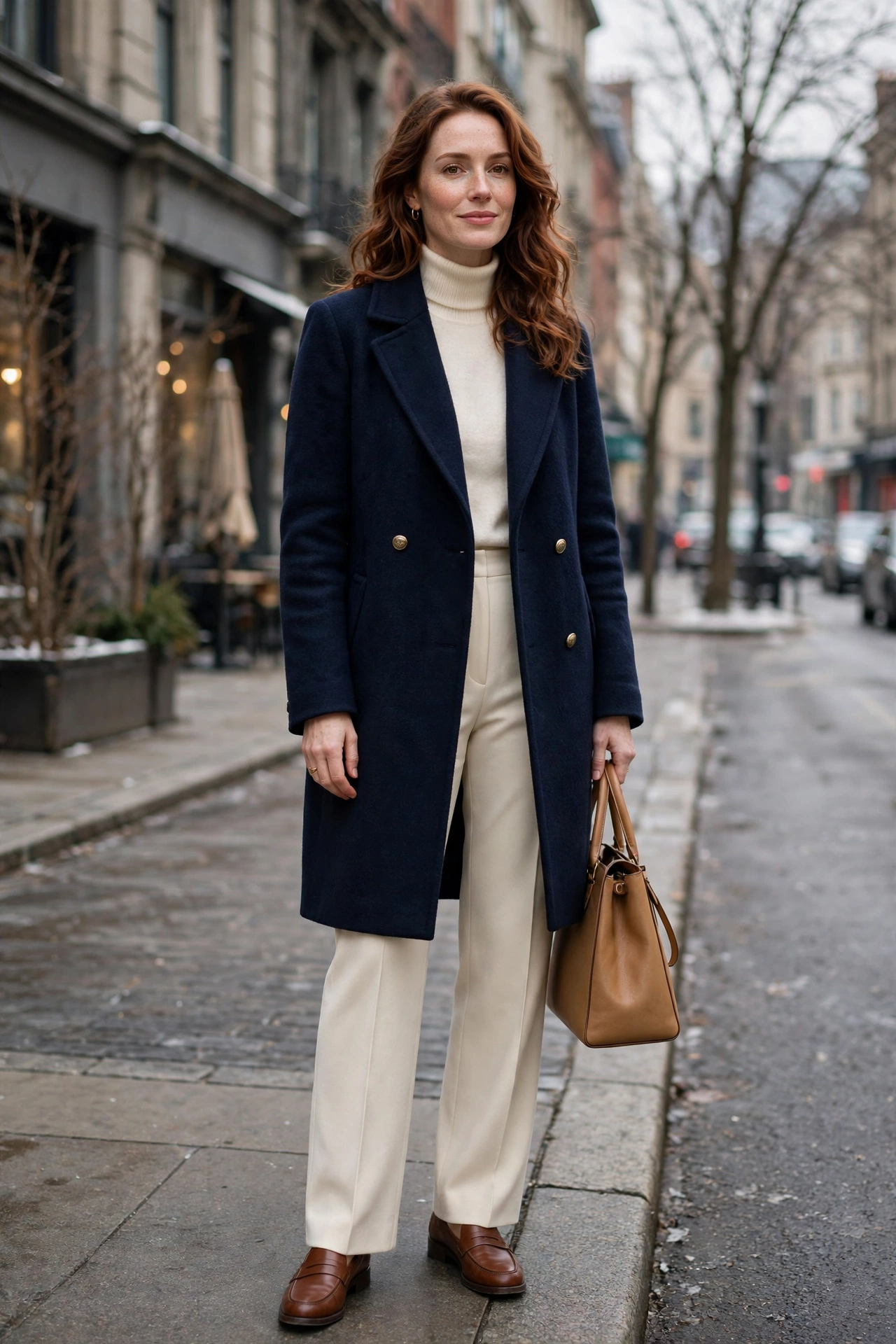
Navy is the most versatile coat color there is, and it is the safest answer when your closet is a mix. It works with black, gray, denim, cream, brown, olive, and burgundy, which is a wider range than any other color on this list. It is softer than black, so it never looks severe, and it works for the office, the weekend, and an evening out.
Navy flatters cool skin tones beautifully, and it suits neutral skin tones too. If your wardrobe is a genuine mix of warm and cool pieces, navy is the color that bridges both sides. It also has a practical advantage: it hides lint and light wear far better than black does.
Navy can look almost black in low light, so wear something lighter underneath, a cream knit, a pale shirt, or a light scarf, and the navy reads as navy again.
Charcoal
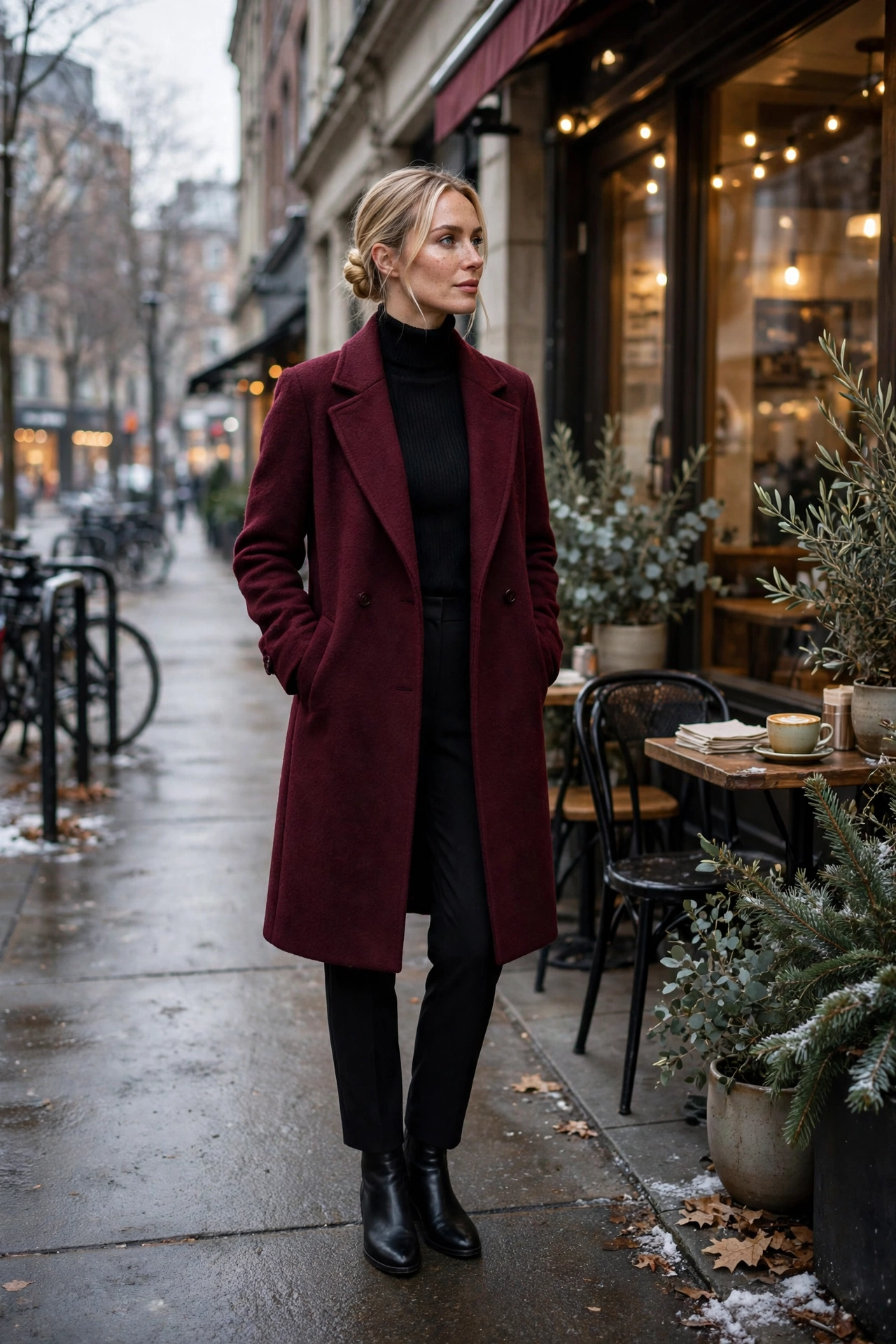
Charcoal is the quiet professional of the group. It is softer than black and less stark, it works with everything navy works with, and it also pairs well with brown, which navy does less naturally. If your life is mostly office and meetings, charcoal is a superb first coat, because it looks serious without looking severe.
Charcoal suits cool and neutral skin tones, and it is a good choice if black feels a little harsh near your face. It hides lint better than black and never fights with the colors underneath it.
Its weakness is personality. Charcoal can read a little flat on its own, especially in a plain cut. That is easy to fix with texture, a scarf, a pair of gloves, or a bag in a warmer color, but if you want your coat to do the talking, charcoal will not do it alone.

Chocolate Brown
Chocolate brown is the color of this winter. Across the season’s trend coverage, brown is the shade that keeps appearing, in chocolate, tobacco, cocoa, and mole, and it has earned its place because it is softer than black next to the face, it goes with denim, gray, cream, and plum, and it does not show lint the way black does.
Chocolate brown flatters warm skin tones, especially with red or golden undertones, while cooler skin suits a grayer mole or espresso brown. It is the best choice here if you want your one coat to look current right now, and it is a classic at heart, so it will not look dated in a year or two.
The one rule with chocolate brown is to buy a classic shape, not a trend shape. A simple tailored or wrap coat in chocolate brown will look right for years. A novelty cut in the same color will date with the cut, not the color, and that defeats the point of buying one good coat.

Black is the most practical and the most formal choice, and it hides dirt better than any other color. If your wardrobe is mostly black and your life is mostly city and evening, black is a fine first coat and you should buy it with confidence. For most people, navy or charcoal does the same job with more warmth. Black shows lint and pet hair, can look severe in casual settings, and pairs badly with brown shoes and warm earth tones. Black is a good coat color, just not the best first one for most people.

The Short Answer: What We Recommend
Here is the decision in plain form. If your wardrobe leans warm, buy camel. If you want the most current look this winter, buy chocolate brown in a classic shape. If your wardrobe leans cool, buy navy, or charcoal if your life is mostly office. If your wardrobe is a genuine mix, buy navy. If your wardrobe is mostly black, buy navy too, because it is softer than black on black and works with everything black works with.
If we had to pick one color for the most people, it would be navy. It works with the widest range of clothes, it flatters the widest range of skin tones, and it looks polished in every setting a single coat has to cover. Camel is the runner up, and for a warm wardrobe it is the better pick, full stop.
Think one step ahead as well. If you already own a black coat, your next coat should be camel or chocolate brown. If you already own a camel coat, your next coat should be navy. The second coat is where variety lives. The first coat is where versatility lives.
What to Avoid When You Can Only Buy One
Knowing what not to buy is as useful as knowing what to buy, because the wrong first coat is an expensive mistake. Here is what to leave on the rack when you can only buy one.
Bright statement colors are the first thing to skip. A red, cobalt, or emerald coat can be gorgeous, but it is hard to pair, it is memorable, which means people notice when you wear it twice in one week, and it tires fast. Save the bold color for a scarf, a bag, or a second coat.
White and cream coats are beautiful and impractical as an only coat. They show every mark, every splash, and every bit of city grime, and they need constant cleaning. If you love light colors, wear them underneath your coat, not as the coat itself.
Bold patterns and big checks have the same problem as bright colors, only more so. A large plaid is memorable, it limits what you can wear underneath, and it can feel repetitive within weeks. A subtle herringbone reads as a solid color from a few steps away and gives you the same versatility.
Shiny finishes deserve a warning too. A glossy puffer or a high shine shell reads brighter and more saturated than the same color in a matte wool, which can push a soft, muted color too vivid near your face. Matte wool is the most forgiving fabric for testing a new coat color, because it shows the color close to how it looks in shade.
Trend shapes are the last thing to avoid as a first coat. A cropped faux fur jacket, a cape, or a very oversized shape can be wonderful as a second piece, but a cape leaves your arms less covered, a cropped length leaves your legs to fend for themselves, and an extreme shape is hard to wear every day. Buy the classic shape first. Trends are for the second coat.
And one general rule. Do not buy a coat that only works with one outfit or one occasion. If you cannot picture it over your work clothes, your weekend jeans, and something dressy, it is not your one coat.
One Coat, Four Ways to Wear It
A single coat earns its keep by how many outfits it can carry, so here is what one good coat can do across a normal week.
For work, wear it over a fine knit and tailored trousers, with loafers or knee boots. The coat does the polishing, so the pieces underneath can be simple. A slim belt bag or a structured tote keeps the look tidy.
For the weekend, wear it open over jeans and a striped top, with ankle boots or clean sneakers. Let the coat hang open so the outfit underneath shows, and push the sleeves up slightly if the shape allows it. The coat becomes the layer that pulls a casual outfit together.
For an evening out, wear it over a dress, with heeled boots, a small bag, and simple earrings. A long coat over a dress looks intentional and elegant, and the coat itself becomes part of the outfit rather than something you rush to take off at the door.
For something dressy, wear it over a slip skirt or wide leg trousers, with a silk top or a fine knit. The coat adds structure to soft pieces and keeps the whole look warm without hiding it.
Accessories are what keep one coat from feeling like the same outfit every day. A scarf, a pair of gloves, a different bag, and different boots change the coat completely. That is the real secret of a one coat wardrobe. The coat stays the same. Everything around it changes.
How to Make One Coat Last for Years
A coat you can only afford once has to last, so the fabric and the fit matter as much as the color. Here is what to check before you pay.
Check the label first. A coat that is mostly wool will be warmer, will hold its shape better, and will look better after a season of wear than a coat that is mostly polyester. Cashmere and camel hair blends add softness and warmth without weight. A lining matters too. A lined coat is warmer and slides on more easily over thick knits, while an unlined coat drapes beautifully but is better suited to milder days.
Length is the next decision. Knee length is the most versatile length there is, long enough to be warm, short enough to be practical. Longer is warmer, and a coat that covers your thighs makes a real difference when you are standing still on a cold morning. If you are petite, look for hip length to just above the knee, because a very long coat can swallow a small frame. If you are tall, midi and maxi lengths look best, and tall sizing matters more than people expect, because it is what makes the sleeves reach your wrists.
Fit is what you see and fabric is what you feel, so try the coat on over your thickest sweater, not over a thin top. The shoulder seam should sit at or just past your natural shoulder on a tailored coat, and you should be able to cross your arms without the back pulling. The sleeves should end at your wrist bone. If the coat only fits over a thin layer, it will be uncomfortable in real winter weather, so size for the sweater.
Care is simple and it makes a real difference. Brush the coat after wear to lift dust. Spot clean small marks quickly instead of letting them set. Dry clean sparingly, because too much dry cleaning wears wool out, and always use a wide, sturdy hanger so the shoulders keep their shape. In summer, store the coat in a breathable garment bag with cedar to deter moths, and keep it out of damp.
A coat you wear most days for several winters is the cheapest item in your closet per wear, while a cheap coat you wear ten times is not a bargain at all. Spend what you can on fabric and fit, not on a label.
Frequently Asked Questions
Is black or navy better as a first coat?
Navy is better for most people. It works with more colors, it is softer near the face, and it pairs with brown shoes and warm earth tones that black fights with. Black is better if your wardrobe and your life are mostly dark and urban, and if you already own mostly black clothes and black boots. If you are torn between the two, navy is the safer first buy.
Can I wear camel if I have cool skin?
You can, with one adjustment. Camel is a warm color, so if your skin is cool, wear a scarf in your best cool neutral between the coat collar and your face. A soft gray, a slate blue, or a cool cream scarf does the work near your skin while the camel does the work everywhere else.
What if my wardrobe is half warm and half cool?
Choose navy. It is the color that bridges both sides, because it works with warm browns and creams just as well as it works with cool grays and blacks. Charcoal is the second choice for the same reason. Avoid camel as your only coat in a mixed wardrobe, because it will fight with the cool half of your closet.
Should I buy the trendy color or the classic color?
Buy the classic shape in the current color. Chocolate brown is the color of this winter and also a classic, so a simple tailored coat in chocolate brown reads current now and classic later. If you are nervous about trends, buy navy or camel and add the trend with a scarf or a bag. Never buy a trend shape as your only coat.
The Bottom Line
One coat, one color, one decision. Start with your closet, check your skin tone, and choose from the four colors that actually earn their keep. If your wardrobe leans warm, buy camel. If you want the most current look this winter, buy chocolate brown in a classic shape. If your wardrobe is a mix, or you want the single safest answer, buy navy. It works with the widest range of clothes and skin tones, it looks polished everywhere from the office to a night out, and it will still look right in three winters.
Whatever you choose, choose it on purpose. Try it on over your thickest sweater, walk to the window, check your face, and picture it over the five outfits you wear most. The right coat makes getting dressed easier every single morning.
For more guides like this one, visit the Style Guides section on The Style Eve at /style-guides/.